
Exploring Falling In Autistic Older Adults
Background
Falling and fall-related injuries are significant public health issues for older adults because falling in older adulthood can impact ability to participate in daily activities, lessen independence, and increase healthcare costs. Older adults who are autistic may be at greater risk for falling for many reasons, including difficulties with motor coordination, co-occurring health problems, or use of antipsychotic medication, which is commonly prescribed for autistic people. Understanding how often autistic older adults receive care for falls can help in developing effective interventions that will meet the needs of autistic adults.
Community Insight
Part of this research project involved talking to autistic adults in the community. They shared insight into how specific autistic experiences like difficulty with proprioception (being aware of your body in space) and interoception (being aware of how your body feels internally) can impact not only the risk of falling but also whether injuries from falls are recognized as important and consequently receive appropriate care. These are just some of the ways that being autistic can impact experiences of falling.
Study Purpose
No research to date has looked at falling among autistic older adults. This study aimed to compare the odds of experiencing a fall and the rate of falling-related injuries that occurred in a sample of autistic adults compared to a similar group of non-autistic older adults.
Study Information
Methods
The research team used Medicare claims data from 2013-2021. The sample included 10,677 autistic older adults (aged 65+) matched to 21,351 non-autistic older adults on sex, race, region, rurality, and enrollment year.
Falls were defined and identified according to specific codes from the International Classification of Diseases (ICD). When analyzing the data, the research team looked at three variables: (1) any fall at all; (2) number of serious falls that resulted in hospitalizations; and (3) number of unique injuries from falling.
Results
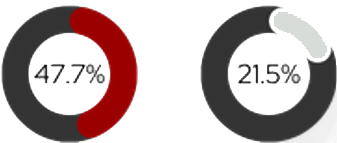
Represented by the donut graphs on the near right, almost half (47.7%) of autistic older adults (red section) had at least one fall compared to 21.5% of non-autistic older adults (light grey section).
Additionally, significantly more autistic older adults had fall injuries and hospitalizations from falling (seen in the bar graphs on the far right).
Injuries & Hospitalizations
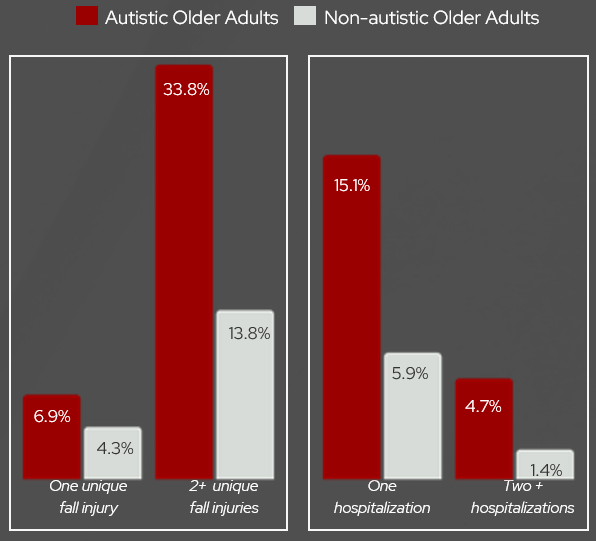
Graph 1 Description:
Autistic adults (red) had more injuries from falls, with 6.9% having one unique fall injury and 33.8% having 2 or more fall injuries, compared to 4.3% and 13.8% in the general population (light grey), respectively.
Graph 2 Description:
Autistic adults (red) had more hospitalizations from falls, with 15.1% having one hospitalization and 4.7% having 2 or more, compared to 5.9% and 1.4% in the general population (light grey), respectively.
Findings
Likelihood and Rates of Falling
The research team also calculated the odds of experiencing a fall during a given year, finding that autistic older adults were approximately three times more likely to fall in a given year than non-autistic older adults.
The team also calculated incidence rates of severe falls, which compares how many falls were observed for both groups in a given year, finding that autistic older adults had more than double the rate of severe falls (falls that resulted in hospitalizations).

Fall Interventions
Because falling is a significant health issue for older adults in general, there are already existing interventions aimed at preventing falls for the general population. These can include balance training or making changes to living spaces. However, interventions designed for the general population often need to be specifically adapted to meet the needs of autistic people; adapting existing interventions should be a priority for future work.
Limitations & Next Steps For Research
The findings from this study may not generalize to future populations of autistic older adults because of diagnostic changes over time; our sample was born before autism was added to the Diagnostic and Statistical Manual (DSM), so it may exclude people who may be autistic but never got diagnosed. Additionally, our study did not look at all risk factors for falling, like epilepsy or living situation, so more research is needed to explore other factors that might influence falling. Future research should also include younger autistic adults to understand if the risk of falling occurs at younger ages for autistic adults than for the general population.
Key Takeaways
This research project found that autistic older adults have higher odds of falling and are more likely to experience injuries and hospitalizations from falling compared to non-autistic older adults.
These results could make sense when considering that the autistic population experiences risk factors like connective tissue disorders and proprioception difficulties more than the general population.
It is important to keep these findings in mind as you consider your own experiences and plan for your safety and the safety of your loved ones.
STUDY CITED
Bishop L, Blake M, Nikahd M, Hyer JM, Patterson BW, Wolf BJ, Hand BN. Falls and Fall-Related Injuries and Hospitalizations in Autistic Older Adults: A Medicare Data Study. Autism. 2026 Apr 27:13623613261433988. doi: 10.1177/13623613261433988. Epub ahead of print. PMID: 42037214; PMCID: PMC13124077.