
Risk Factors For Dementia Among Autistic Older Adults
Why Is This Important?
Autistic people experience higher rates of dementia than non-Autistic older adults. Neurocognitive disorders like dementia are a leading cause of loss of independence in older adults, so it is important to look at what might contribute to these higher rates. We know there are certain risk factors (for example, diabetes) that can influence the likelihood of experiencing dementia, but we don’t know how these risk factors might have a different influence specifically for Autistic older adults.
These findings emphasize that risk factors may impact the Autistic population differently. They highlight the importance of tailored screening and prevention strategies in this underserved and ageing population.
Study Purpose
This study looked at how the known risk factors that can influence the likelihood of dementia–like obesity and diabetes–might explain the higher rates of dementia experienced by Autistic older adults compared to non-Autistic older adults. The study team also wanted to see if there was any difference after taking into account whether Autistic older adults had or did not have an intellectual disability.
Study Information
Methods
The research team used data from Medicare, a publicly funded health insurance for Americans aged 65+. The sample included 9,201 Autistic older adults and 18,356 population controls matched by characteristics like age, sex, and known risk factors like diabetes, obesity, and hypertension. The primary goal was to see how the difference in dementia rates between Autistic older adults and non-Autistic older adults changed when the known risk factors were accounted for. The secondary goal was to see if these results would be different depending on whether Autistic older adults had an intellectual disability.
Results
After taking into account known risk factors, Autistic older adults had a 20% higher risk of neurocognitive disorders like dementia compared to non-Autistic older adults. Among the risk factors that the study team included, Autistic older adults had the highest risk for dementia if they had the following risk factors: hypertension, high cholesterol, depression, and diabetes. Additionally, the study team found that the risk of dementia was significantly higher for Autistic older adults with intellectual disability compared to non-Autistic older adults; there was virtually no difference for Autistic adults without an intellectual disability compared to controls.
Conclusions
Autistic older adults had a 20% higher risk of neurocognitive disorders than non-Autistic older adults, but this elevated risk is driven primarily by autistic adults with co-occurring intellectual disability.
The Role Of Intellectual Disability
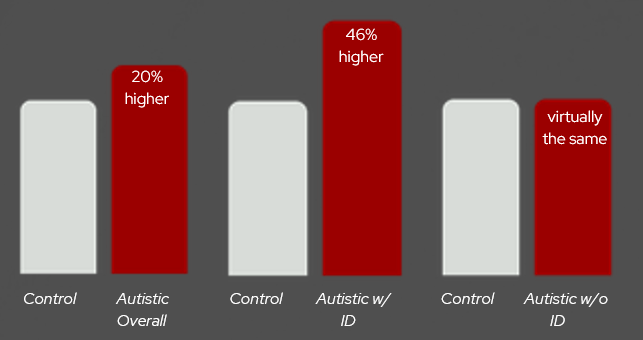
The elevated risk observed in the results is driven primarily by autistic adults wth co-occurring intellectual disability (ID). This means that most of the difference in risk between the autistic and non-autistic groups was accounted for by co-occurring ID.
Risk Factors Explained
What Are Risk Factors?
According to the National Cancer Institute, risk factors are conditions, behaviors, or characteristics that can increase the likelihood that an individual develops a disease, injury, or negative outcome. Some risk factors, like diet, are modifiable; other risk factors, like family history, are fixed and can’t be changed.
Why Are Risk Factors Important?
Having certain risk factors can impact the likelihood of developing a disease, so understanding risk factors are crucial because they help to identify groups of people who have a higher risk. This can inform health decisions, guide preventive actions, and inform policy changes.
Study Limitations
This study used Medicare, which is specific to the US healthcare system and only captures diagnoses that are observed and recorded during health care visits; therefore, people with less or no healthcare access might be underdiagnosed for neurocognitive disorders like dementia, which means that our study may not have captured the whole picture. Additionally, there are other known risk factors for experiencing dementia–for example: vision loss, social isolation, physical inactivity, and others–that weren’t available in the dataset, so there may be other parts of the picture that we missed because of the limitations of the dataset.
What You Can Do

Many risk factors are modifiable, meaning an individual can change something about their lifestyle to address risk factors. The most influential risk factors in the study were hypertension, high cholesterol, depression, and diabetes. You can take action to manage these risk factors by eating a healthy and nutritious diet, exercising regularly, lowering your stress, and getting regular check-ups.
Next Steps For Research
This study compared the risk of neurocognitive disorders like dementia among Autistic older adults compared to non-Autistic older adults, finding that Autistic older adults had a significantly higher risk of dementia compared to their non-Autistic peers. Some of the risk factors associated with this elevated risk were modifiable, indicating that there is an urgent need to develop tailored intervention strategies to improve the management of these modifiable risk factors among Autistic individuals. It is also important to strengthen early identification efforts for dementia, especially for individuals with intellectual disability.
Study Title, Authors & Affiliation
“Risk of Dementia and related neurocognitive disorders among autistic and non-autistic older adults: the role of established risk factors”
Nikahd, M.1, Hyer, M.1, Wolf, B.2, Patterson, B.3, Bishop, L.3, & Hand, B.N.1 (2024)
1The Ohio State University; 2Medical University of South Carolina; 3University of Wisconsin – Madison